
Getting started
How to Design a Custom Crochet Graph
Build a blank-first graph with custom color labels, cell proportions and saved row notes.
Decide What One Cell Means
Choose stitch or block units before drawing. Define the construction of that unit in your own project instructions. The graph does not produce free-form crochet symbols, shaping or block construction.
Set Up a Blank Graph
Choose width and height, then Blank grid. Adjust the cell height-to-width ratio for the on-screen preview. The printout records the ratio but uses square reference cells for readability.
Label Your Materials
Choose a palette entry, set its name and reference color, then draw or fill cells. Labels and colors are saved with the project and printed in the key. They are custom references, not official yarn catalog matches.
Mark Rows with Notes
Select a row and enter a short note. Notes appear in local drafts, project downloads and printing. To remove a note, clear its field. Use Make mode to track completed rows separately while drawing is locked. Progress is included in drafts and downloaded projects; changing a row clears its completion mark. Download a backup before clearing browser data.
Review Reading Direction
Row 1 is at the bottom. Flat rows alternate direction; unturned rounds keep the same direction. Select a first direction and confirm that row-run counts sum to the graph width.
Keep an Editable Copy and Print
Save project keeps the graph type, proportions, colors and row notes. Print / Save PDF includes the legend, chart pages and row guide. Reopen the JSON in Crochet Graph Maker to retain its settings.
Crochet graph Questions
Is this pattern maker free?
Yes. Free includes local conversion and editing up to 160 × 160, plus PNG, CSV, JSON and basic PDF printing without an account. Maker Plus supports up to 400 × 400. Cloud saving requires sign-in; Free accounts can save 5 cloud projects.
How should a beginner start?
Try a sample first, then use a small grid and a few colors. Review individual cells and print a test page before starting a large project.
Can I draw my own chart online?
Start with a blank graph (8–160 columns and rows on Free, up to 400 with Maker Plus), choose the cell height-to-width ratio and draw a motif. This workflow is designed for manual graph planning; image import is available as an optional starting point.
Can I design a blanket with a custom picture?
Yes. Draw a motif or import an image and decide whether each cell means a stitch or a block. For single-crochet colorwork with measured gauge, use the Tapestry maker. The graph does not generate blanket construction or diagonal C2C instructions.
Can I set the number of stitches and rows?
Yes. Set width and height from 8 to 160 on Free, or up to 400 with Maker Plus. These settings apply to the next generated or blank chart. Use Resize existing canvas to add space or crop an existing design without resampling it.
Can I make a chart and save a printable PDF?
Yes. Create or edit your chart, open Export settings, choose A4 or Letter, then use Print / Save PDF. Select Save as PDF in your browser’s print dialog. Check the saved file; canceling the dialog creates no PDF.
Can I save my progress?
Yes. Local drafts and downloaded JSON preserve your chart and row progress. Sign in and choose Save to cloud to continue on another device, then save changes explicitly. Signing in does not upload local projects automatically. Keep a separate JSON backup.
How is this different from the tapestry tool?
The graph workspace starts with a blank design, supports stitch or block labels, freely adjustable cell proportions and saved row notes. Tapestry uses a measured single-crochet swatch.
Does it create crochet symbol diagrams?
No. This tool creates grid-based charts, not free-form crochet symbol diagrams.
Does every square mean one stitch?
Only when you select stitch units and your technique uses that convention. Block mode deliberately labels each cell as a block; no block construction is generated.
Can I add row notes and print them with my graph?
Yes. In Design mode, select a row, enter a note and choose Save row note. Notes are included in project files and the printed row guide. Make mode tracks completed rows separately. Cloud projects require sign-in and an explicit save; local edits are not automatically synchronized.
Practice with a Working Digital Sample
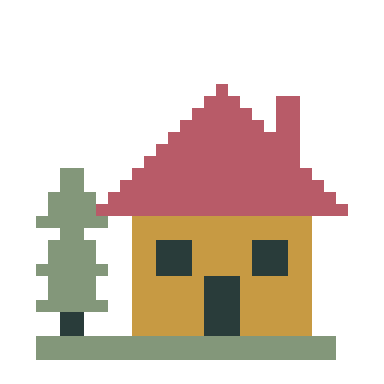
Pine cottage · 32 × 32 · Blank-first color grid · Stitch or block labels · Custom palette, cell proportions and row notes
Crochet graph Guides & Help
Design a Crochet Graph from a Visual Reference →
Start with a blank grid, define stitch or block units and build a motif with labels and row notes.
Organize Graph Layouts, Repeats and Row Notes →
Use selection and canvas controls carefully, then preserve a clear legend and working notes for your graph.
Add Names and Short Messages to Your Pattern →
Preview block lettering, fit it to your chart and preserve the result in any of the five makers.
Save, Back Up and Resume Your Patterns →
Save local or cloud projects, keep editable backups and resume row progress across all five makers.
Choose PDF, PNG or CSV and Check Print Settings →
Pick the right export, match paper settings and review page boundaries before making your project.